Monday, February 18, 2013

~Paris Planning~2013

In 2 months we will be on our way to Paris for the 5th time. I've been calling it the "Paris Finale" because the decision to go was based on my mobility or lack thereof.
On previous trips the planning stage was almost as exciting as the vacation itself; researching sites, finding new resources, reading travel guides etc, etc. But this time it is different.  After exploring the city 4 previous times, the search becomes more difficult, not because it's hard to do. The reason is that the neighborhoods (arrondissements) have so many interesting 'hidden' places.  The more I read, the more I find.  It becomes overwhelming~to the point of research paralysis.

I've given this a lot of thought and have decided that the frustration and difficulty comes from the issue of this being the last trip. So, I'm changing that idea~it is not the last trip.
I'll never give up being able to go to Paris.

A couple of nights ago I was reading my DK Eyewitness Travel Guide for Paris.   (I love the "Eyewitness Travel Guides", they're very well organized, include great information, photos and detailed maps).  While reading, I found myself thinking, seen that, seen that, been there ~page after page.

I have many, many guide books~Rick Steve's France, Fodor's Paris, Frommer's Paris, Lonely Planet and Michelin Green Guides.  I have books for finding the best walks, the cheapest restaurants, the 10 best sites and things to do.  For this trip, I added several new travel books:

This little book Markets of Paris is a great guide to the city's food markets, antique markets, flea markets and artisan shows.
It is organized by arrondissement, especially good if you are already familiar with the city, and includes great directions, times and dates.

Another great find was Discover Paris by Metro put out by RATP (the public transportation operator in Paris) and the City of Paris.  This book describes each line of the Metro, stop by stop.  It lists sites to see, places to eat, museums to visit at the more prominent stops on each line.


Since I love architecture, I found Five Hundred Buildings of Paris a wonderful resource. The photos are black and white, the buildings are described by arrondissement and each is referenced in the back of the book with detailed information about the building's history.  This would be a great guide to have for siteseeing if it weren't small, thick and heavy.  Nonetheless, it is worth it's weight!

My favorite books though are the  Thirza Vallois'  Around and About Paris series. Each book in the series covers several arrondissements (1-7, 8-12,13-20).

These guides are not for the first time traveller unless you are extremely interested in history.
Arranged chronologically by arrondissement, the author,first, gives a thorough description of the neighborhood with detailed history about the people, places and events associated with the area.  The introduction is followed by interesting walks through the neighborhood with accompanying maps.


And so, I have a renewed enthusiasm for planning.  I've decided on a variety of themes for photographs and exploration ~Art Nouveau architecture, shop windows (my favorite), parks, gardens, squares & courtyards,art, cats, aerial views, Faubourg St. Antoine ~to name a few.  The only guides I will take with me will be the new edition of the Michelin Green Guide and my well-worn Knopf Mapguide of Paris.

Now, I must get back to Paris~planning.     Au revoir.

Tuesday, January 1, 2013

~Paris Exposition Universelle of 1900~


The Exposition Universelle of 1900 was held in Paris from April to November 1900,
to celebrate the achievements of the past century and to accelerate development into the next.
Panoramic view of both exposition centers
 Eight years before the launch of the 1900 Paris Exposition Universelle, the Republic of France announced the exhibition to be one which welcomed and celebrated the coming of a new century. Countries from around the world were invited by France to showcase their achievements and lifestyles.  The support for the exhibition was widespread, foreign countries immediately began to plan their exhibits,

The fair displayed, in view of over 50 million people, many machines, inventions, and architecture that are now (nearly) universally known, including; escalators, the Eiffel Tower, Ferris wheels,  Campbell's Soup, Diesel engines, talking films, and the telegraphone (the precursor to modern-day sound recording).  Russian sparkling wine defeated all the French entries to claim the internationally coveted "Grand Prix de Champagne". The exposition also showcased another Russian entry, the widely famous Matryoshka doll (Russian Nesting Doll).
The Russian Pavilion
Matryoshka Nesting Dolls

Many of the buildings and statues of the world’s fair were made of staff,  a low-cost temporary building material invented in Paris in 1876, which consisted of jute fiber, plaster of Paris, and cement. The temporary buildings were built on a framework of wood, covered with staff, which was then formed into columns, statuary, walls, stairs, etc. After the fair was over, the buildings were demolished.  All items and materials that could be salvaged and sold were “recycled”.


The site of the exposition, along the Seine, linked four originally unconnected districts of the city. The construction of the Pont d’Iena connected the Trocedero with the Champs de Mars, situated on the opposite bank of the Seine, to form the main exposition complex.
The Trocedero


View of the Trocedero from the Champs de Mars

Palais de l'Electricite

The site continued along the banks of the Seine up to the area in front of the Invalides, where it was planned to build a second centre.  A newly built esplanade which led from the Hotel des Invalides over the new Seine bridge, the Pont Alexandre III,  to the opposite bank. This formed the second exposition center.
Pont Alexandre III
Palais of the Nations

  The continuation of the esplanade, the Avenue Nicholas II, extended the route past the two planned palaces of art, the Petit Palais and Grand Palais, to the Champs Elysees. This proved to be a magnificent street system which soon received praise as a brilliant invention for the exposition.
The Grand Palais
The style that was universally present in the Exposition was Art Nouveau.  Exposition Universelle structures, such as the Porte Monumentale entrance, the Pavilion Bleu and the Grand and Petit Palais, were largely oriented around the Art Nouveau theme. The Petit Palais, was constructed to hold the exhibition of French art, but is known mainly for its Art Nouveau inspired iron work and general design. Much like the Grand Palais, the Petit Palais combines the styles of Neo-Baroque and Art Nouveau.
Porte Monumentale
The Petit Palais
Rue de Rivoli along the Tuilerie Gardens

Despite the initial enthusiasm, the 1900 Paris Exposition Universelle was not a financial success as only two thirds of the expected public was in attendance. It was such an expensive exhibition to organize and run that the costs for the average citizen to see specific attractions would be about six hundred francs in addition to their admittance ticket. The 1900 Exposition Universelle lost a grand total of eighty two thousand francs after six months in operation.

The financial implications of the 1900 Exposition Universelle devastated Paris` people and resulted in the decision to end the streak of international fairs with the 1900 loss.

Saturday, November 10, 2012

~It's Official~ Paris in May 2013

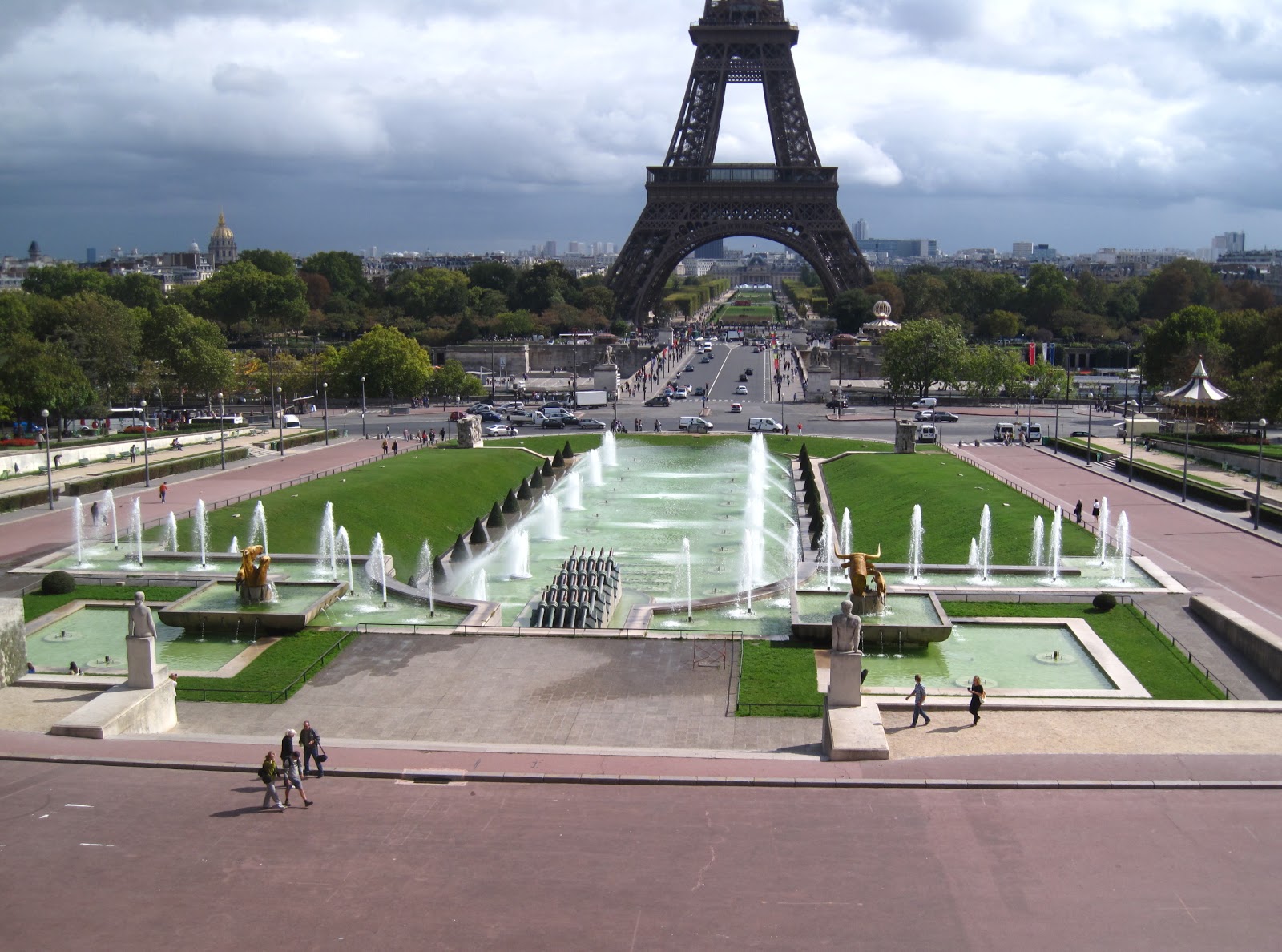
We have our airline tickets and have reserved an apartment in Paris for the month of May.  This time we will be staying in the 16th arr. on the rue Gustave Courbet.  It's not far from the Trocodero across the river from the Eiffel Tower.

This will be a new area for us to explore.  The 16th is mostly residential with many Embassies and high-end shops.  There are many museums clustered around the Trocodero.


The Bois de Boulogne and Parc de Bagatelle have been on my list for years, but since it was so far out we never ventured that way.  Now we will be on that side of the city and it is on the top of my list.  We should be there in time to see the Iris Garden in bloom.


I do a lot of research before our trips, always trying to find something new and different to see and do.  While doing my routine search, I came across this interesting site~Guided Photo Tours in Paris.  Having a professional photographer take you on a personal tour with personal instruction sounds perfect to me.  A photo tour of Montmartre would be wonderful.   So, that's on my 'to do' list too.

There are still many museums we haven't seen;  the Architecture Museum (I read that the cafe has a fabulous view of the Eiffel Tower) and the Counterfeit Museum are on the top of the list.  Of course, we will go to the Louvre again.  It's so big that there is always something new to discover.

There 2 areas of Paris that have also been on the list for several years~ Buttes aux Cailles and Canal St-Martin.  Check the link~I have mentioned the Canal St-Martin before.  It runs from the Bastille northeast to the Parc de Villette and is supposed to be a beautiful quiet walk. 


 Located on a hill, Buttes aux Cailles is a lesser known neighborhood in the 13th arr.  It has a village-like atmosphere with winding, narrow cobblestone streets.


As I add to my list, I will share more of the "Paris 5"  itinerary~ a bientot!